


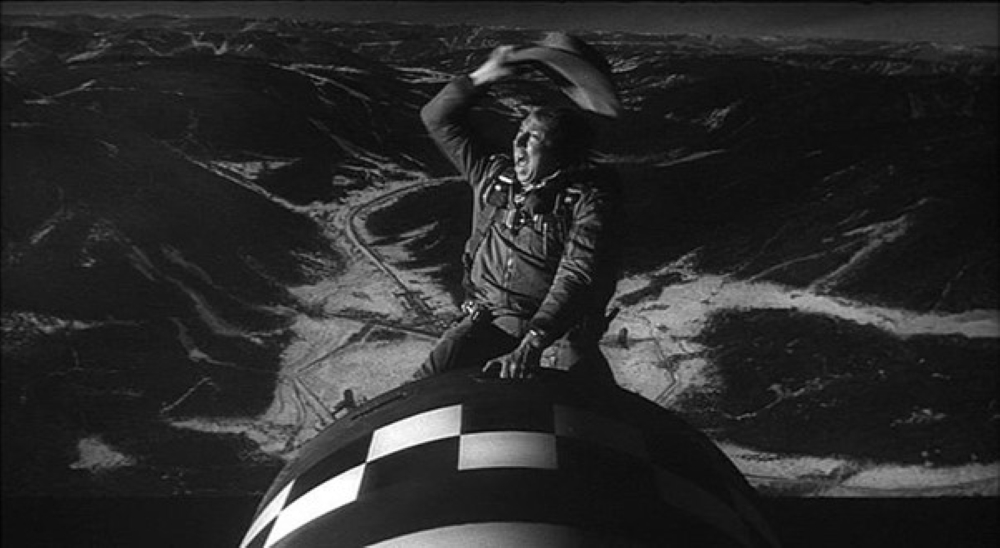
Or: How I Learned to Stop Worrying and Love the Bomb. Is it me or does that sound like a 70s prog rock song?
“Next up on Classic Rock we have Dr. Strangelove with How I Learned to Stop Worrying and Love the Bomb.”
Side note: a working title for my magnum opus on giant spider movies is How I learned to stop worrying and love those oversized octo-legged arthropods.
The weird part of that is, up until now, I was referencing a movie I hadn’t seen. But I have now corrected that horrendous oversight because you voted for me to watch and review Dr. Strangelove as part of my IMDB Top 250 project.
Dr. Strangelove has the longest title of any best picture Oscar nominee, fact fans. Its afterglow remains imprinted on popular culture in various ways: Major Kong riding a nuclear missile like a rodeo cowboy. “You can’t fight in here…this is the war room!” The concluding food fight in the war room.
Wait…what do you mean the food fight isn’t in the movie? We see a full buffet laid out. How can it not happen? That’s like not firing Chekov’s gun.
I found out later that the food fight was a deleted scene. I must have heard about it and mistakenly thought it was part of the movie. Shame. I think it would have worked brilliantly.
Dr. Strangelove in the Multiverse of Madness
The plot of Dr. Strangelove concerns a rogue US army officer who orders America’s B52 bombers to nuke Russia. The US President scrambles to avoid world annihilation with the help of his war room.
It’s a comedy.
The story isn’t a comedy – it’s horrifying to the point that the movie has to reassure us with an opening crawl stating that this definitely couldn’t happen in real life. Honestly.
But the characters that inhabit this worst-case scenario? Imagine Monty Python’s Schindler’s List.
The first thing to say about Dr. Strangelove is that keeps to a tight 90-minute runtime. Kubrick keeps his indulgences to a minimum, although some scenes still run long. We spend a lot of time with a B52 bomber crew as they run through their various protocols, or with the President and his war council as they argue over what to do.
It’s actually quite tense in the early stages, and I was wondering when the comedy was going to happen.
I like the long take scene early in the movie featuring Dr. Strangelove’s only female character, Miss Scott (Tracy Reed). She talks on the phone, relaying a conversation between an Air Force officer and General Buck Turgidson (George C Scott) while wearing a bikini.
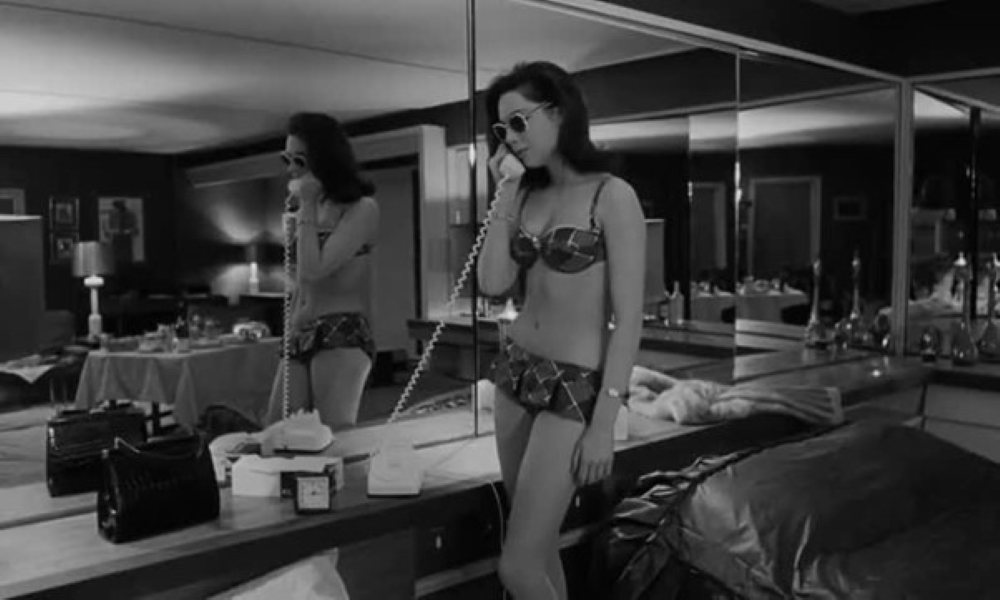
I bet the notoriously obsessive Stanley Kubrick shot a few unnecessary takes of that scene. Or had his OCD not fully kicked in yet?
I tend to think not, seeing as Dr. Strangelove is essentially the Peter Sellars show. Sellars ad-libbed his scenes and refused to shoot more than two or three takes. His loose, improvisational style should, on paper, have clashed with Kubrick’s precise, methodical nature.
A Man of Many Faces
But somehow it didn’t. Kubrick seems happy to just point the camera at Sellars and let him do his thing. Sellars plays three characters in the movie: US President Muffley (looking oddly like Stanley Tucci), RAF Officer Mandrake and Dr. Strangelove himself.
Sellars was originally lined up to play Major Kong as well. Columbia Pictures only agreed to finance the film if Sellars played multiple roles, like his multi-persona performance in Lolita (1962). But circumstances led to him vacating the Kong role and Slim Pickens was cast instead.
Sellars plays Mandrake as a stiff upper lipped British officer who finds himself uncomfortably subservient to crazy Brigadier General Jack D Ripper (haha), played by Sterling Hayden. It reflects Britain’s post-WW2 role as junior partner to the world’s brash new superpower.
After Ripper initiates Armageddon with righteous zeal, Mandrake attempts to coax the cancel codes from him with all the authority of Oliver Twist asking for more gruel.
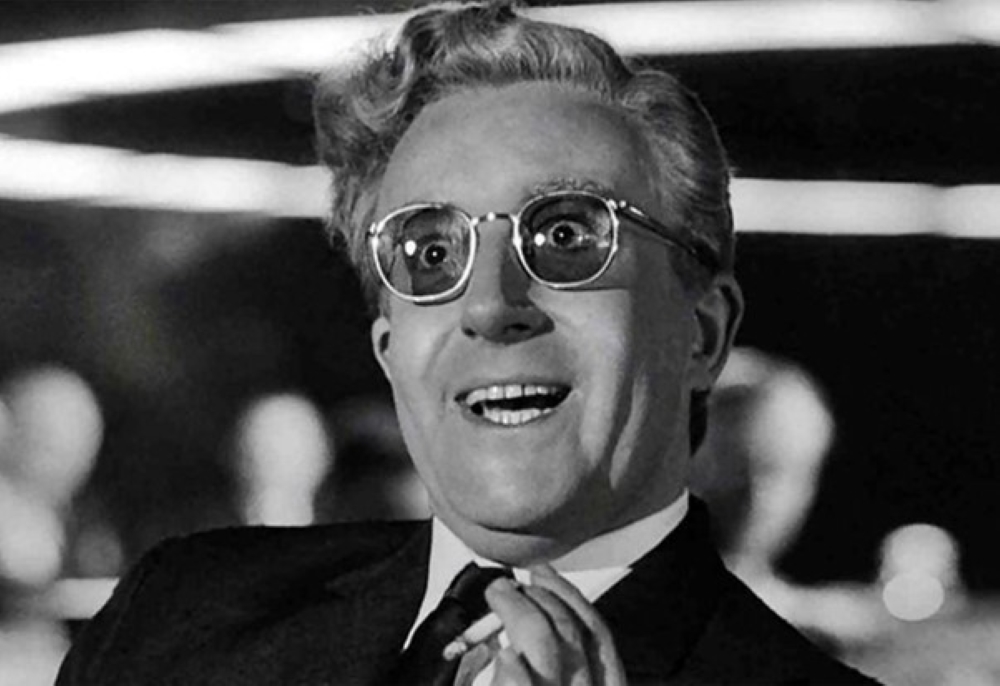
Dr Strangelove’s title character only appears in two scenes, but they are both memorable. Sellars is completely in his element as the wheelchair bound ex-Nazi scientist now working for the Americans.
Dr. Strangelove combines Tourettes-style outbursts of ‘Mein Fuhrer!’ with a sentient right arm that throws up Nazi salutes and keeps trying to strangle him.
Sellars’ President Muffley is more of a straight man, and some of his scenes I found to be hit-and-miss. While I appreciate the level of ad-libbing and comic timing it must have taken to film his phone conversation with the Russian President, he says the word ‘Dimitri’ way too many times and the scene borders on indulgent.
Nominative Determinism
The crazy characters don’t end with Peter Sellars. Everyone has a novelty name and a personality to match.
Slim Pickens, who also had a novelty name in real life, plays Major Kong straight – the yee haws are unironic and all the better for it.
George C. Scott overacts to perfection and Sterling Hayden remains deadpan as he drones on about ‘bodily fluids’ and ‘purity of essence.’ Ripper’s plan has a certain cold logic to it and you can almost see his point.
Despite the slapstick, Dr. Strangelove never seems frivolous due to the inherent nature of the subject matter and the movie’s unwillingness to take the easy way out. Satire is the perfect way to illustrate the lunacy of nuclear war and the egos that could trigger one.
Thankfully, Dr. Strangelove remains a warning rather than a prophecy. But if the end comes, just know that I’ll be throwing on Vera Lynn’s We’ll Meet Again and celebrating the irony.


