


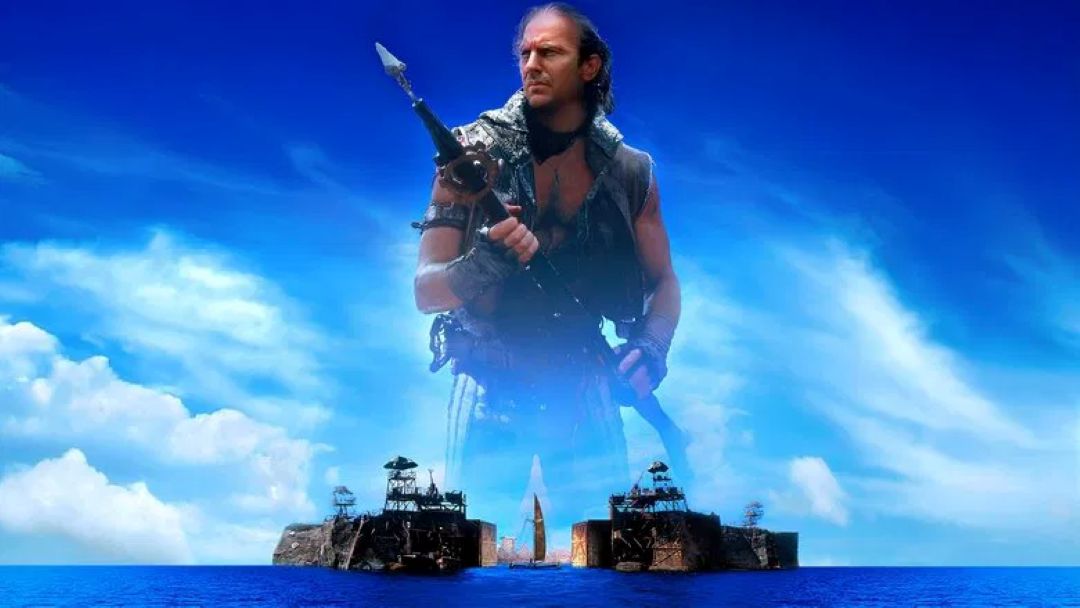
There was a time when Kevin Costner could do no wrong. Not literally, obviously. Somewhere in America there was probably a man who watched The Postman and thought “This is the greatest thing I’ve ever seen,” but cinematically speaking, Costner in the late 1980s and early 1990s was bulletproof.
The Untouchables, Bull Durham, Field of Dreams, Dances with Wolves, JFK, Robin Hood: Prince of Thieves, Even The Bodyguard, a film whose primary contribution to cinema was convincing an entire generation that Whitney Houston staring at a man while someone played a synthesiser was actual acting.
Costner was THE guy. And then, at the absolute height of his cinematic powers, when Hollywood was perfectly happy to throw money at him until the oceans boiled, he looked at Mad Max 2, and apparently said:
“Yeah. That. But wet.”
And so we get the damp Beyond Thunderdome that was Waterworld.
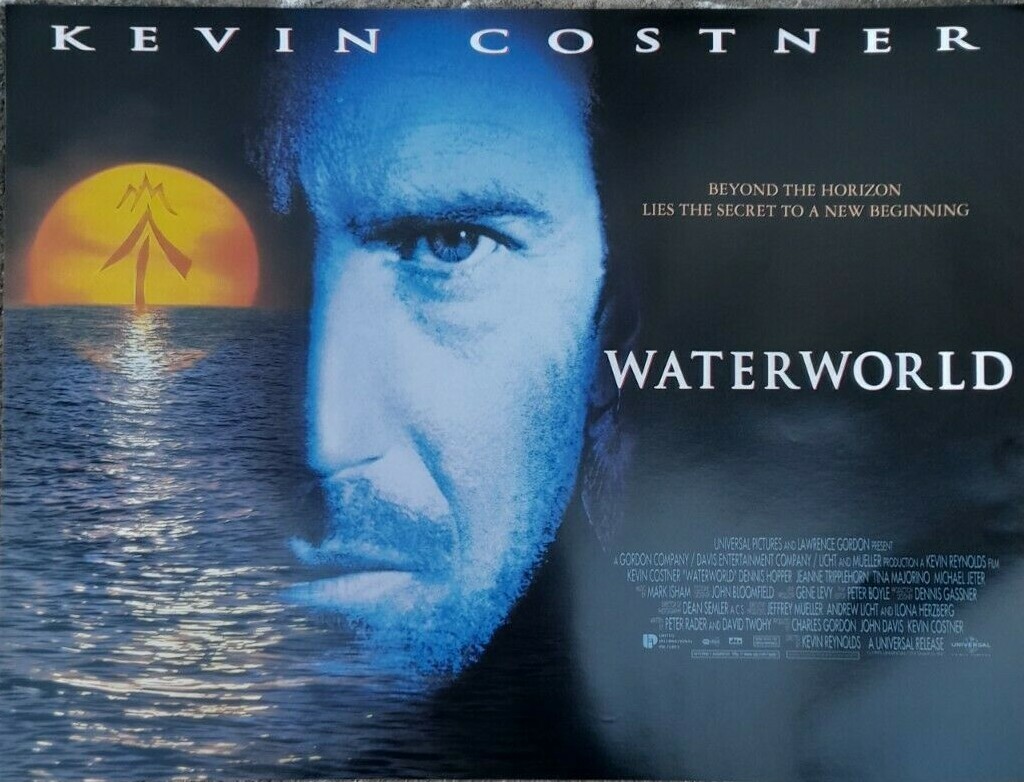
Waterworld
It’s the future. A very specific kind of mid-90s enviro-panic realised future. The polar ice caps have melted. The Earth is completely covered by water. Humanity has adapted to life on the oceans, living on floating atolls, scavenging ancient artefacts from the drowned world and generally having a miserable time.
This is actually a pretty good premise. It’s basically Mad Max 2 crossed with Beyond The Poseidon Adventure, except the entire planet is the ocean and everyone has somehow forgotten how to use boats properly.
Enter the Mariner, played by Kevin Costner – He is a mysterious loner. He is a skilled sailor. He has webbed feet. He has gills.
Yes. Kevin Costner has gills.
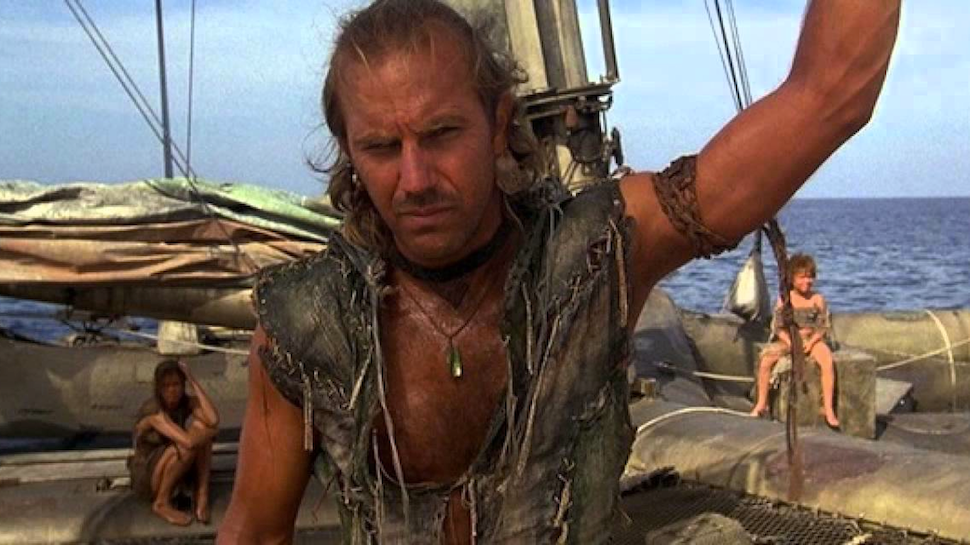
This is never really explained in any satisfactory way. He just has them. He’s basically Aquaman if Aquaman hated people, smelled like fish and had spent several years being designed by a production design committee that had just discovered The Creature from the Black Lagoon. And because this is 1995, nobody seems particularly interested in asking the obvious question: “Why?”
The Mariner can breathe underwater. Fine. How did this happen? No idea. Why hasn’t evolution produced anyone else like him? Don’t worry about it. Why does he apparently possess a fully functioning digestive system despite being approximately 60% aquatic? Shut up!
The greatest irony of Waterworld is that the filmmakers spent an absolutely obscene amount of money creating a world that looks surprisingly cheap. This was supposed to be the ultimate post-apocalyptic nightmare. Instead, everyone looks like they’ve just come from wardrobe at a theme park.
The bad guys are called the Smokers. They live on a floating fortress made out of old oil tankers and assorted bits of maritime junk. They wear leather. They ride jet skis. They have tattoos. They smoke cigarettes. They’re essentially the biker gang from any number of dystopian movies after someone accidentally left them in the bath. Must have been a soapy bath, because they all suspiciously clean.
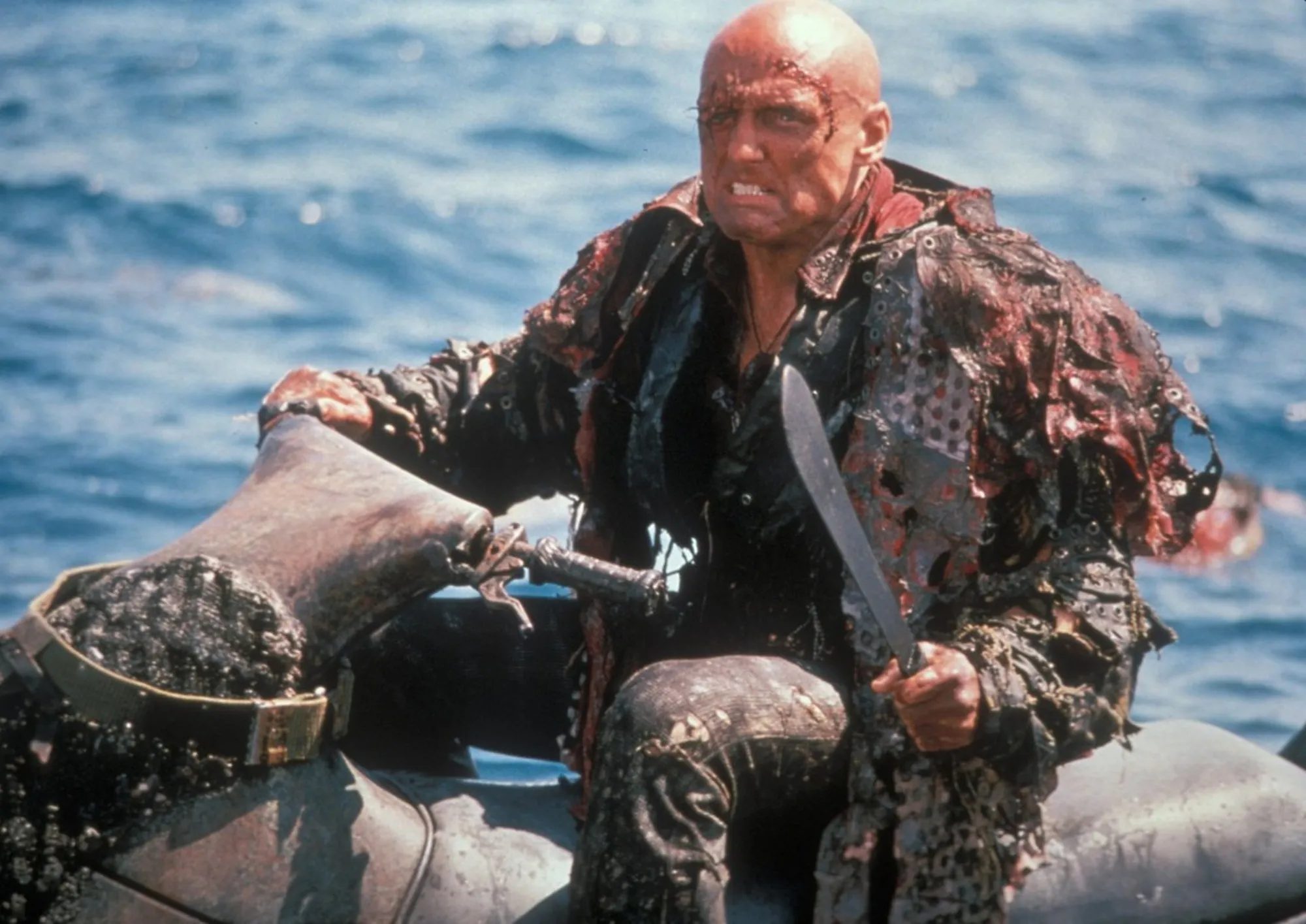
This is a world where civilisation collapsed centuries ago, humanity has supposedly been reduced to scavenging for survival, and somehow Dennis Hopper has access to a pair of perfectly pressed trousers.
This extends beyond the bad guys. Nobody looks particularly dirty. Nobody looks particularly dehydrated. Nobody appears to have scurvy. Nobody seems to have wondered where their next dental appointment is coming from.
The Mariner, meanwhile, has a spectacularly well-maintained trimaran and enough fuel, rope and mechanical equipment to run a small offshore oil platform. Because apparently the apocalypse is only really inconvenient if you’re an extra.
Hopper plays Deacon, the villain of the piece, and God bless him for trying. He is both magnificent and terrible. Deacon leads the Smokers and wants Enola, a young girl played by Tina Majorino, because she has a map tattooed on her back which supposedly leads to Dryland.
The last piece of habitable land on Earth has been tattooed onto the back of a child. This is either an ingenious plot device or the result of a screenwriting meeting where somebody said:
“People like treasure maps.”
“Where do we put it?”
“On the kid.”
“Good. Ship it.”
The Smokers are looking for Dryland because, naturally, everyone desperately wants to find the mythical place where you can stand up without drowning.
And that’s the whole plot. Everybody wants the girl. Everybody wants the map. Everybody wants Dryland. Nobody wants to sit down and discuss why the world’s most valuable geographical information was apparently encoded in the dermatological artwork of a child.

The Great Mid-90s Rising-Sea Panic
There is something wonderfully nostalgic about Waterworld because it captures the particular flavour of 1990s environmental apocalypse. This was the era when popular culture became convinced that the planet was approximately five minutes away from being destroyed.
The ozone layer was collapsing. The rainforests were disappearing. Acid rain was going to melt us all as we tried to do some yard work. The ice caps were melting. And somewhere in the middle of all this came Waterworld, essentially asking: “What if all that, just a lot!?”
This is pre-Al Gore An Inconvenient Truth, remember. Climate anxiety had yet to become a TED Talk. There was no smartphone app telling you your personal carbon footprint. Instead, Hollywood just took Kevin Costner, put him on a boat and spent the GDP of a small African nation showing you what happens when the ice melts.
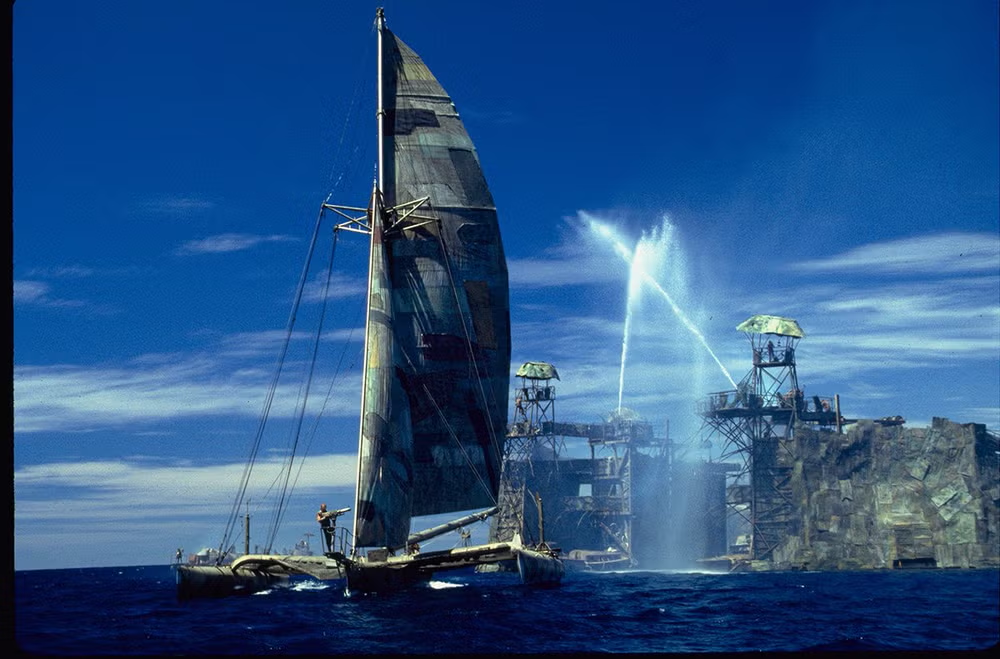
It’s all spectacularly unsubtle. The opening shot literally shows the Universal logo being swallowed by water. That’s either symbolism or a remarkably expensive cry for help. Speaking of expensive, you can’t discuss Waterworld without talking about the production, and this is where Waterworld becomes considerably more entertaining than the actual film itself.
The making of Waterworld was a catastrophe of almost biblical proportions. The original budget was around $100 million, then it became $135 million, then around $175 million. Then $200 million depending on who was doing the accounting and how much shame they were willing to experience.
At the time it was being described as the most expensive film ever made. And they weren’t spending that money on CGI. This wasn’t some enormous digital production where half the budget went on rendering computers. They actually built the bloody thing.
The floating atoll weighed around 1.68 million pounds and was held in place by four enormous anchors.
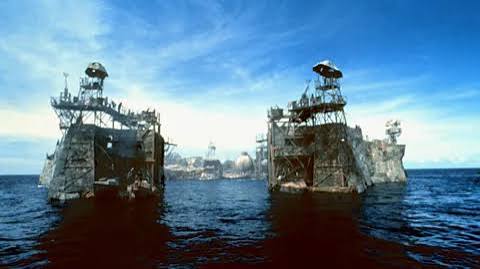
They built boats. They built floating sets. They filmed in the actual ocean. And then the ocean, having presumably read the script, decided it wasn’t interested in helping. The weather was terrible. The water was rough. The wind was unpredictable. Sets were damaged, while another major set sank, and the shoot ballooned to 166 shooting days.
At one point, the production apparently had around 500 extras and dozens of boats operating simultaneously. The production was described in contemporary reports as chaotic and logistically awful, with weather, shifting seas and organisational problems contributing to the escalating cost. And then Costner and director Kevin Reynolds fell out.
Because apparently the only thing Waterworld needed was another disaster.
Reynolds eventually left during post-production, with Costner taking greater control of the film. This was particularly unfortunate because Costner and Reynolds had previously made Robin Hood: Prince of Thieves together.
So imagine going from making one of the biggest films in the world to ending your friendship over a movie where Kevin Costner has gills? Cinema is a strange business.
The Costner Problem
The funniest thing about Waterworld is that Costner is clearly playing this as though he’s making The Godfather of the sea. He is committed. He broods. He stares. He growls. He stands on his boat looking into the middle distance as if the fate of mankind rests upon his ability to maintain a convincing expression while surrounded by water. And, honestly, he’s pretty good.
Costner isn’t bad in Waterworld. The film is bad, and he just happens to be standing in it.
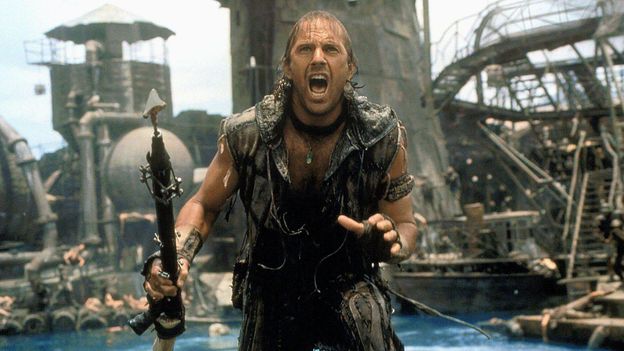
At this point in his career he had enough clout to get a movie like this made and enough confidence to believe he could make it work. And you can see why. There are some genuinely fantastic ideas here.
A world where people live on floating communities. A civilisation built around the ruins of the old world. The Mariner’s strange biology. The floating atoll. The Smokers. The idea of an entire planet being one enormous frontier.
It should be brilliant. Instead it becomes a two-hour-plus collection of boats crashing into things while Dennis Hopper shouts.
The biggest problem is that Waterworld knows exactly which film it wants to be. The aforementioned Mad Max 2.
The influence is enormous. The lone warrior, the post-apocalyptic wasteland, the ragtag settlement, the savage raiders. The desperate search for resources and a battle against a charismatic villain with vehicles and chases.
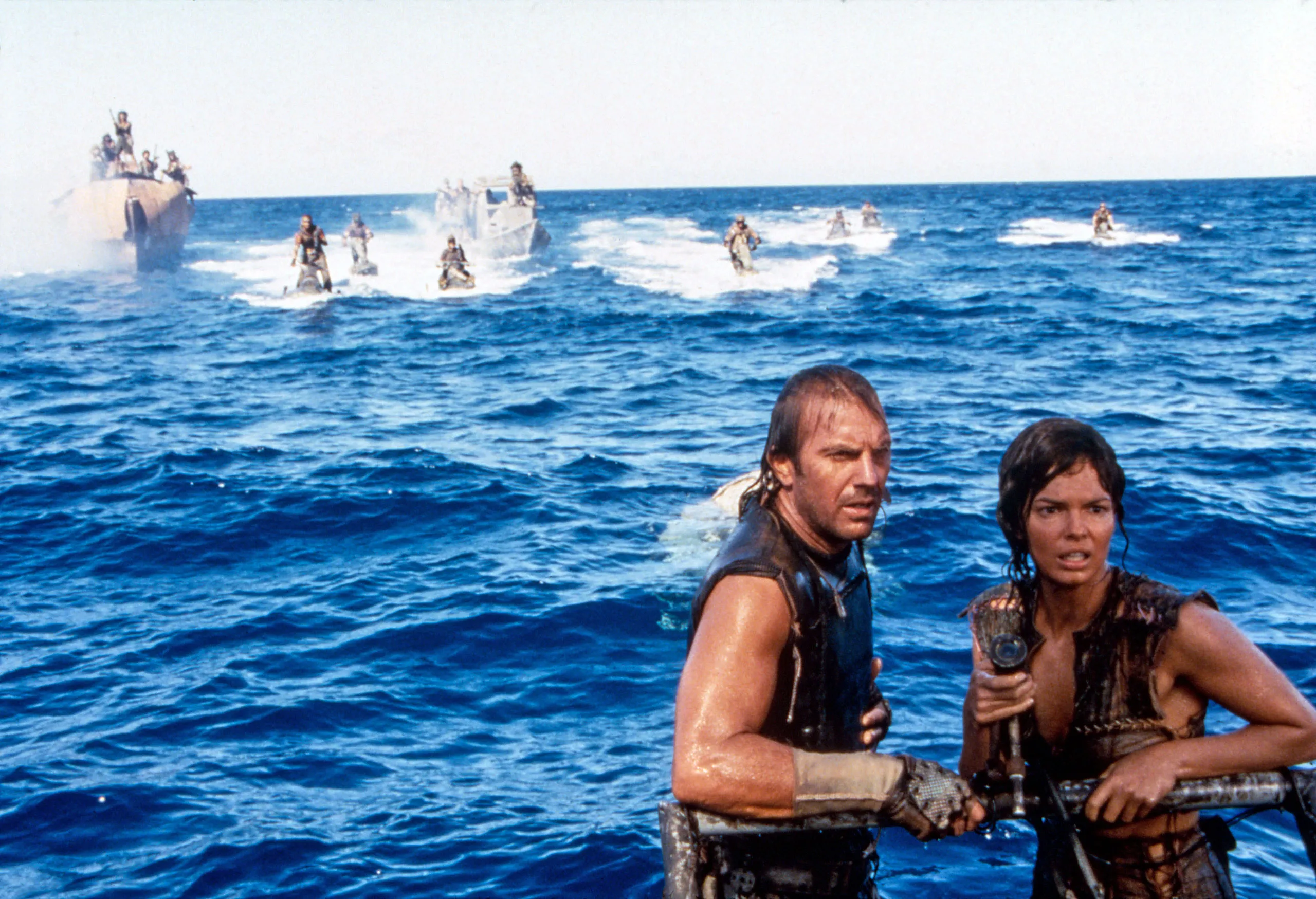
Only George Miller understood that a post-apocalyptic film works best when you keep it lean, brutal and simple. Waterworld takes the same ingredients and decides it needs approximately $200 million, 166 shooting days and an ocean. So it’s Mad Max 2 after having a power shower fitted.
Here’s the weird part. It’s still watchable, though.
Objectively? It’s an awful movie. The dialogue is ropey, the science is laughable, the plot is thin, the characters aren’t especially compelling, the villain is a cartoon, the costumes look cleaner than they should, the gills are ridiculous yet somehow under-developed plot-wise. The environmental premise is ludicrously overcooked. And there is absolutely no reason this movie needed to cost anywhere near what it cost.
And yet… you put it on and somehow you’re still watching twenty minutes later. Then forty. Then suddenly you’re thinking:
“Actually, this floating city is quite cool.”
Then Dennis Hopper turns up and something explodes, and you are all in.
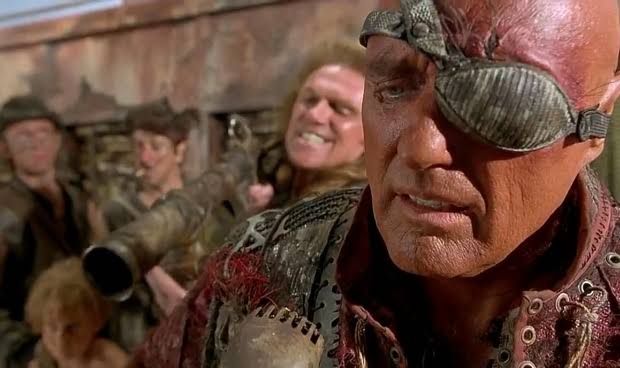
It’s cinema junk food. An enormous, soggy, wildly overcapitalised cheeseburger. With Waterworld, the sheer insanity of its existence becomes part of its entertainment value. It went on to gross around $264 million worldwide, and did good numbers on home video and television sales. It didn’t flop, but it didn’t soar.
Today, I view it as a curious movie artefact. A movie made at the precise moment when Kevin Costner was at the summit of Hollywood, when studios would apparently give him enough money to build an artificial island in the Pacific.
We really won’t see days like those again.

