



How do you like to rate movies? Ebert and Siskel gave a thumbs up or thumbs down. IMDB uses a straightforward 1-10 scale. Rotten tomatoes doesn’t grade a movie’s quality directly but uses a binary positive/negative score to calculate the percentage of reviews that are positive. In my view, it’s not worth a damn.
The most popular method of rating movies has to be the 5-star system. But even here, differences between outlets emerge. Some allow for half stars, which means the score is still out of 10.
Empire magazine uses five stars but doesn’t permit half stars and 1 is the minimum. It’s the same system you see on sites such as Trip Advisor and Google Maps. This inevitably leads to reviews that begin with the immortal line:
‘If I could give zero stars, I would.’
Last Movie Outpost has, in my opinion, the best rating system of all. We permit half stars and allow for zero-star ratings. Some of you may not know this, but we even have a gold five-star rating, which sits above the regular green five-star rating. This rating is reserved for all-time classics.
When you think about it, our ratings don’t go up to 10. They go to 11.
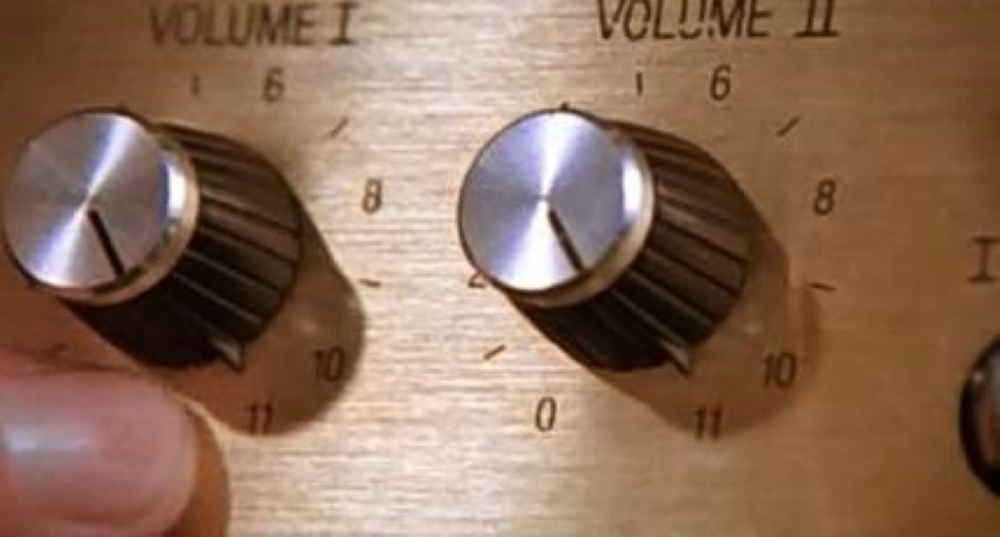
Incidentally, I rate giant spider movies on an 8-leg scale, but that’s more of a novelty than a serious rating system.
Movies are not made equally
That’s all well and good, but I’ve noticed a problem with how people rate movies. It happened at a recent film club, where we each scored the 2014 true story, Philomena, out of 5.
I gave it 3.5 stars. Pretty much everyone else gave it a 5, which offended me.
I mean…Jaws is a 5. The Godfather. The Shawshank Redemption. Insert your favourite movie here. I realise movie ratings are subjective but come on. 5 is the highest mark you can give. Are you really saying that Philomena is one of the best movies ever made?
Don’t get me wrong – Philomena is a perfectly fine human interest story, executed well. The performances by Judy Dench and Steve Coogan are very good. It touches upon the historical injustice of the Magdalene laundries scandal. It does little wrong, so I was forced to ask myself a simple question: why not give it 4.5 or even 5 stars?
I thought about it for a while, and then I had my eureka moment (or brain fart, I’m not sure). It can be best illustrated with a diving analogy.

Difficulty + Execution
Diving judges take two factors into account when scoring dives: difficulty and execution.
Not all dives are created equally. Some are relatively straightforward, such as an inward three-and-a-half somersault in the tuck position, but you already knew that.
Other dives are much more challenging, like the reverse 4½ D-Generation X ‘suck it’ pose in the pike position. I may have made that up, but you get the idea.
The key point is that easier dives have a lower built-in starting score, so even perfect execution won’t get you the top marks. Harder dives create the opportunity for big marks, but only if executed well, which is harder to do, obviously.
In the same way, not all movies are created equally. Philomena is a relatively short, gentle movie with few characters. It tells an intimate tale and only touches lightly on the Magdalene laundry scandal.
This isn’t a criticism. The movie knows the story it wants to tell and it does so. I didn’t score Philomena 3.5 because it was bad. I did it because it wasn’t eligible for a 5. It’s starting difficulty was too low. Only movies that shoot for the stars should be eligible for the full five stars.

Well that’s just like…your opinion, man
The final rogue factor I can’t ignore when scoring movies is one that doesn’t fit the diving analogy: personal taste.
Diving judges can’t mark down a particular dive because it’s not ‘their thing,’ but people do it with movies all the time.
Tarantino once said that Jaws is a perfect movie, but that doesn’t mean you will like it because it might not be ‘your thing.’ You can’t mark it down on execution or difficulty (unless you’re an idiot), but you can mark it down if it just doesn’t vibe with you.
Your vibe might be meditative documentaries on Patagonian sheep farming, and that’s totally fine. You do you.
In my view, personal taste is by far the biggest influence on the ratings most people give. Execution is considered too, up to a point, depending on a person’s knowledge of film. But they aren’t considering difficulty at all.
My new system
Which brings me to my new system for rating movies. It involves scoring a movie on three equally-weighted elements: difficulty, execution and personal taste. Give each element a score between 1-5, then convert it to a percentage of the maximum mark. Here is my score for Philomena:
|
My score |
Max score |
% |
|
| Execution | 4.50 | 5.00 | 90.0% |
| Difficulty | 3.00 | 5.00 | 60.0% |
| Personal taste | 3.00 | 5.00 | 60.0% |
| Average % | 70.0% | ||
70%. Or 7 out of 10. Or 3.5 out of 5.
I didn’t use this system when I rated Philomena – I’m not a total dork. It was more of a gut feel. All these elements are subjective up to a point.
But working it through afterwards at least allowed me to rationalise why someone can give Philomena the same score as The Matrix. They aren’t accounting for difficulty (which can also be expressed as ambition).
So, over to you. Am I thinking along the right lines here or am I way off base? Does any of this matter? How do you like to rate movies, and whose do you trust?

