


Title: Pen Pals
Airdate: 5/1/1989
Plot Summary
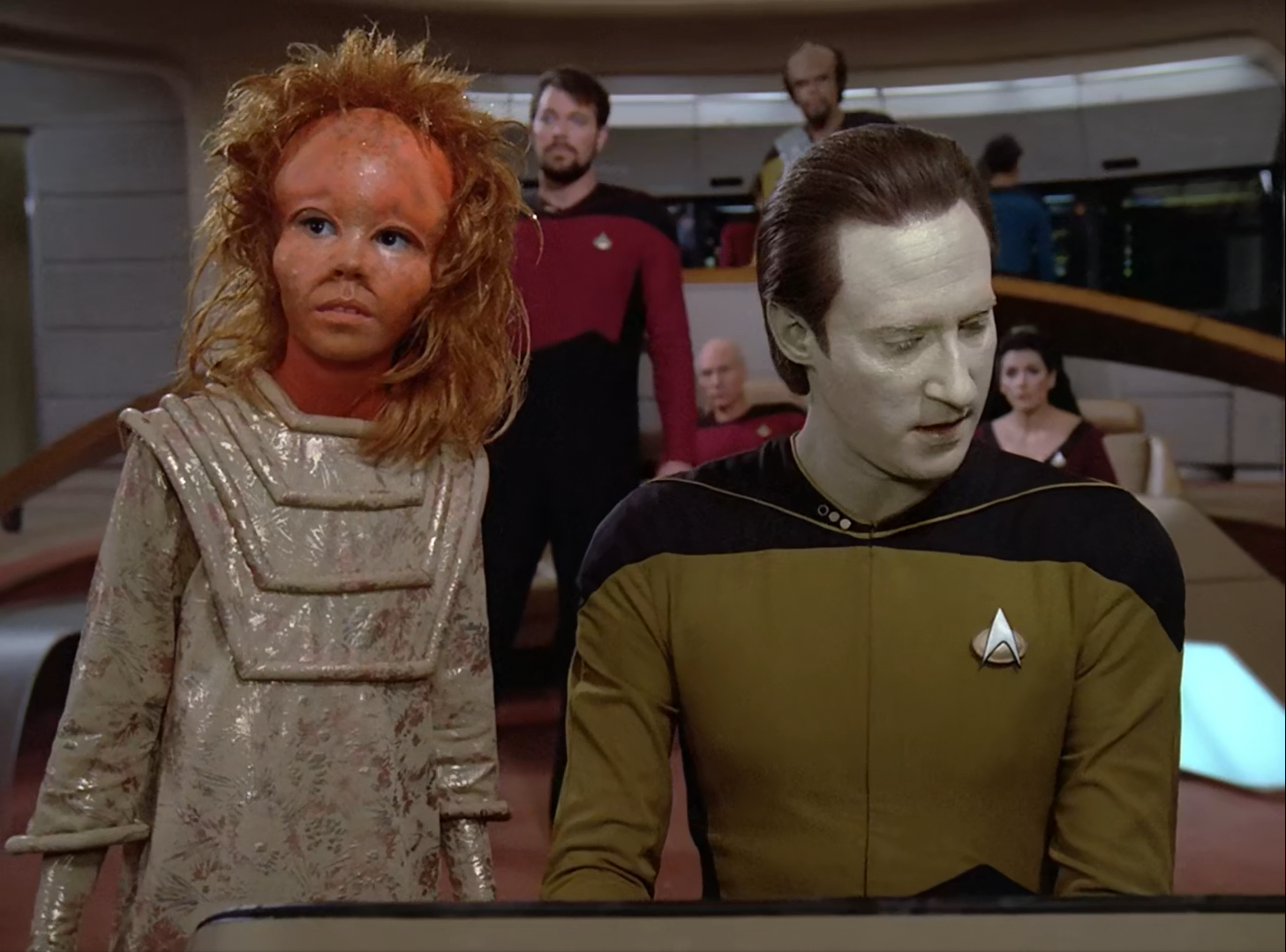
The Enterprise studies a system with planets that have a lot of geological instability. Riker uses this time to give Wesley a team to lead in studying the phenomenon. Meanwhile Data sets up a receiver to monitor the resonance of the instabilities that also picks up communications waves, in this case from a little girl on a planet that is in trouble from the very instability they are studying. He takes the information to Picard and the crew must make a decision on whether or not to help this planet in defiance of the prime directive.
Make It So
Picard is quite gentle with Data and the crew regarding this situation, something he would become a lot more hard nose when it comes to messing with the prime directive. He really wants to help and finally uses the last transmission of Sarjenka to decide to help.
Number 1
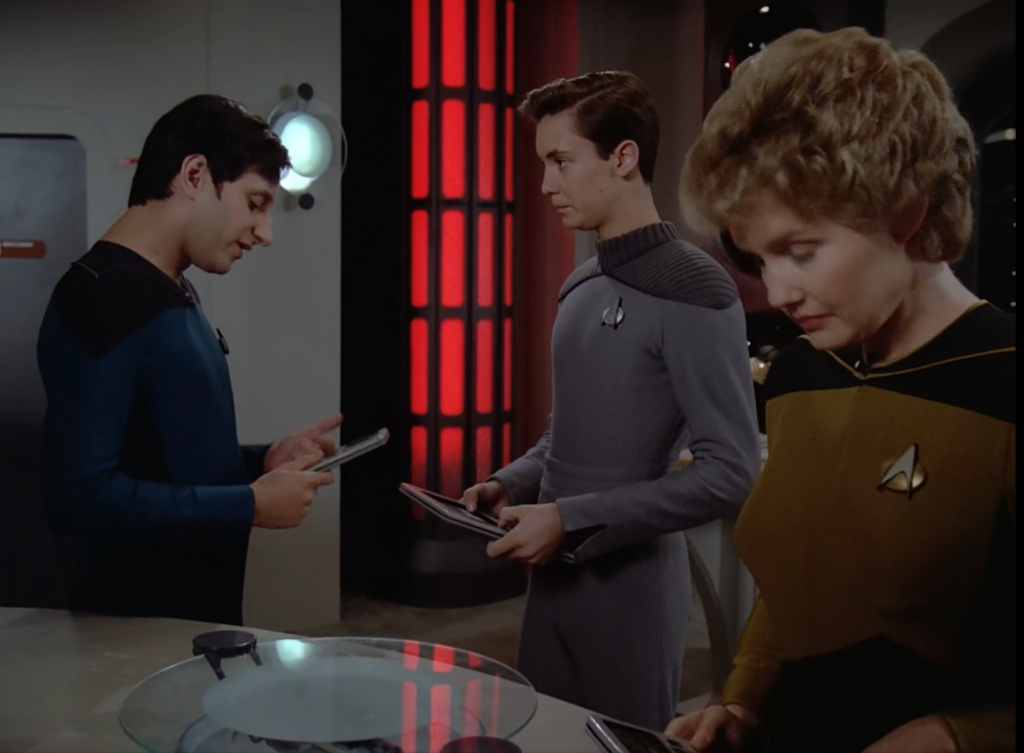
Riker makes the decision to put Wes in charge of the team and the surveys. He believes it’s the right step forward for him.
Fully Functional
Data sets this all in motion by answering Sarjenka’s transmission. He apparently was in contact with her for a few weeks which is really weird for him to so obviously disobey a standing order, in this case the Prime Directive.
Today Is A Good Day To Die
Worf is not happy about crap being left around. He somehow is able to intimidate Data.
He’s the most resolute on how the prime directive should be enforced.
Phase Inducers
Geordi is not happy about letting a planet die and is just as animated as Pulaski, popping up and agitated.
Counselor Cleavage
Deanna clearly is sympathetic to Sarjenka’s plight.
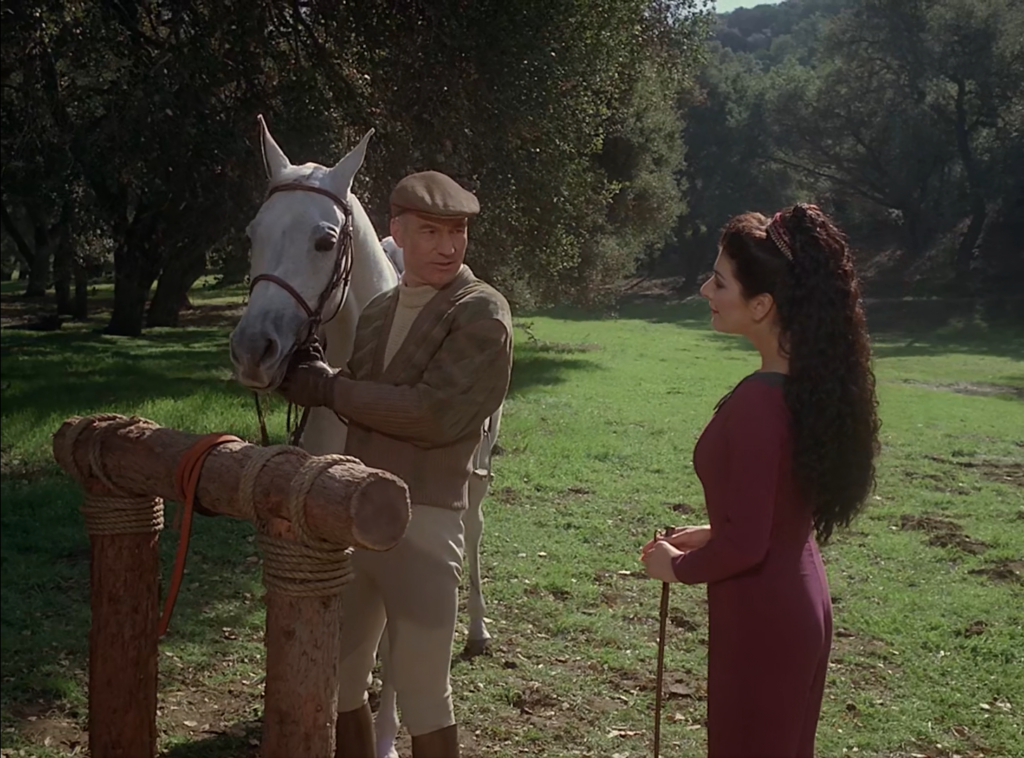
Troi does not like to ride animals. Apparently being an empath or telepath makes it tough.
Doctor Not Bones
Pulaski is dead set against not helping and doesn’t care if she’s being emotional about it.
Shut Up, Wesley
Wes gets put in charge of a planetary geological survey. He has a lot misgivings due to his age, but once he gets his feet under him, he does all right.
Enlisted Man
O’Brien handles the “you didn’t see nuthin” part of his job admirably.
Canon Maker
The prime directive is really put into better focus here, especially for non-warp species. This will be the way things are going forward.
Troi had a cat once. Troi’s mother and it didn’t get along.
Picard’s love of horses is set up here. It would come in handy when he meets Kirk.
Pulaski develops the memory wipe here that will be used throughout the series, and in other series as well.
Canon Breaker
When Picard gets called to the bridge from the holodeck, he begins the process of taking the tack off the horse, as if he’s going to put it back in the stable. Just say “End Program,” Riker’s waiting on you!
I really like the idea of mentoring a kid and putting him in charge of small teams… in regular jobs. It’s one of those things that would never happen on the flagship of the Federation. But here’s where I have to somewhat have to give it a pass, because this kind of messaging to adults and kids I think is great. Pushing kids to take more responsibility, not less, is a great message and one we should embrace. It’s just that realistically, this wouldn’t have happened.
A Little Bloody Nose
No deaths.
Technobabble
Apparently a lot of heat around dilithium deposits can make them move, thereby moving tetonic plates, and finally the planet explodes. One wonders how they hung around long enough to evolve a lifeform that evolved into a civilization since Riker said these planets live fast and die hard.
Please Repeat Your Communication
Riker: You did a good job. I’m proud of you.
Wesley: Thank you sir. Does it get any easier?
Riker: Nope.
— Riker giving Wes a blunt answer on command decisions.
I Know That Guy:
Nicholas Cascone plays Davies and I like his portrayal. He’s just smarmy enough to put the viewer on Wes’s side but not enough to really be a villain, or even an antagonist.
Ann H. Gillespie played Hildebrant. She was probably best known as Jennie Garth’s mother in 90210.
Whitney Rydbeck played Alans. He’s mostly had a career of small, one-off bit parts.
And in a before they were (kinda) famous moment, a very young Nikki Cox plays Sarjenka. She was in the main role in the show Unhappily Ever After for about 100 episodes. She seems to have stopped acting in 2009.
What It Means To Be Human – Review
I can’t understand why I don’t like this episode more than I do. It’s really a question of a the sum is less than its parts I guess. It’s interspersed with some excellent discussions, but tying it all together doesn’t seem to happen like it should. Or at least it doesn’t really grab me.
But for the good. We get Wesley learning his first team leadership assignment. This is really well done. We have him having a lot of doubts about himself, intimidated since he’s so much younger than anyone else. I know I mentioned in the canon breaker that he shouldn’t have been in charge in the first place, but let’s get past that. He makes good decisions and has the same misgivings as anyone his age would in their first big role in a job.
His discussion Riker on what to do and how to move forward was also excellent. Riker explaining that being in charge is never being the boss, it’s a role you must follow.
I also like how Jeffries is portrayed. It might seem arrogant, but I can totally see him really believing he’s trying to help Wesley rather than being a little condescending. I don’t believe he means to be a jerk at all. Considering his age and his rank of Ensign, this makes a lot of sense that he hasn’t gone up higher, though he might just be happy disintegrating rocks in a tube and never tried to move up much. But when Wesley finally gives the order, he follows it without hesitation or complaint. He never gets upset, he tries to make suggestions that he sees as the best. He just comes across a little condescending, as I said. It all felt right.
Then of course we get the argument on how to handle the prime directive. My first problem with this whole thing is that the prime directive should not be a death sentence for an entire planet. How they handled it, quietly and without revealing themselves to the planet’s population is perfect, but why is this a question? To just wash your hands of it all because they don’t have warp capability is a cop-out and I hate that it goes that far.
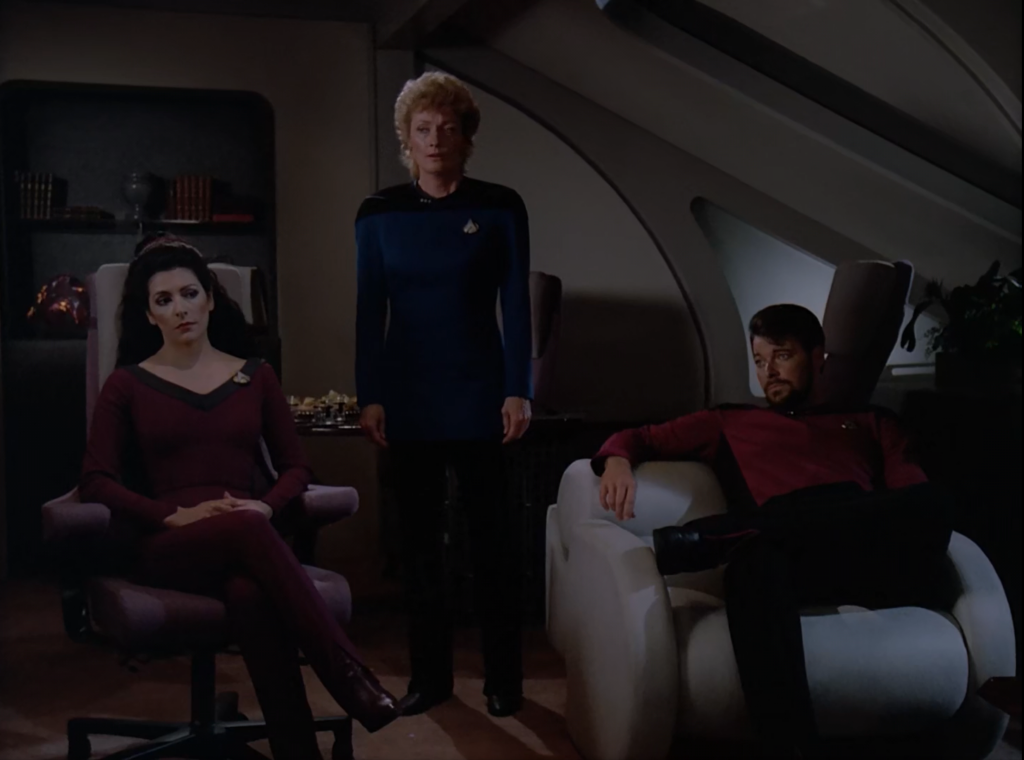
But let’s put that aside. We get to Picard’s quarters and have a pitch perfect direction of the discussion on the philosophy of the prime directive. Worf stands, arms crossed, resolute in the law is the law. Pulaski and Geordi take the other side of the argument, standing up and sitting down, agitated. Riker sits relaxed, contemplative while asking pointed questions of both sides. Picard sits at his desk like a judge listening to prosecution and defense.
The initial discussion is excellent but it starts to break down. Picard says we should help when a planet is going to explode, but what if it’s war? He keeps shifting the goal posts as if those two things are the same. They are not. A natural disaster or extinction event that is out of the inhabitant’s control is not the same as a civilization being too stupid to not destroy themselves. Both are sad, yes. But saving a bunch of people that can’t get it together is probably not the way.
Then the whole discussion gets bailed out without definitively answering the fundamental questions about the prime directive since Sarjenka ends up asking for help.
Then the planet is saved but she will have no memory of Data and no one else on the planet will know. And while Picard and Riker mused how deep they were in this mess, what were the consequences? They didn’t even get a message from Starfleet about the whole thing.
If this had been a prelude to an ongoing conflict in the Federation over the use and status of the Prime Directive over time, then it would have made a lot more sense in the bigger story but this is a one and done. They would continue to be inconsistent with the directive for the rest of Trek.
Still, the moments that are good are so good! It’s hard to not like the episode just for the meeting and Wes’s journey. I just wish it came together better and had more of an impact on the Trek universe.
This is a hard one to rate. I don’t think it’s the best example of a prime directive dilemma episode but I do think it’s required viewing, just for the senior staff argument in Picard’s quarters. Ah hell, I obviously had a lot to say, let’s give it the good rating that it deserves.


