


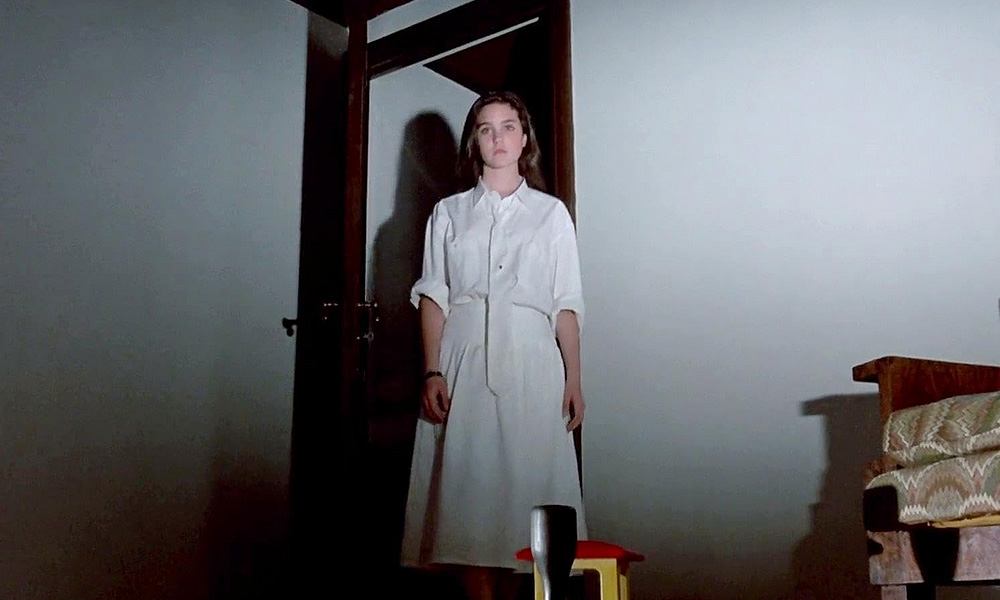
As we have always said, we love contributions from you Outposters. One person who keeps us entertained with his reviews is DwC, and here is a new Masterpiece Theatre of Phenomena.
Directed by Dario Argento
Written by Dario Argento and Franco Ferrini
Starring Jennifer Connelly, Donald Pleasence, and Daria Nicolodi
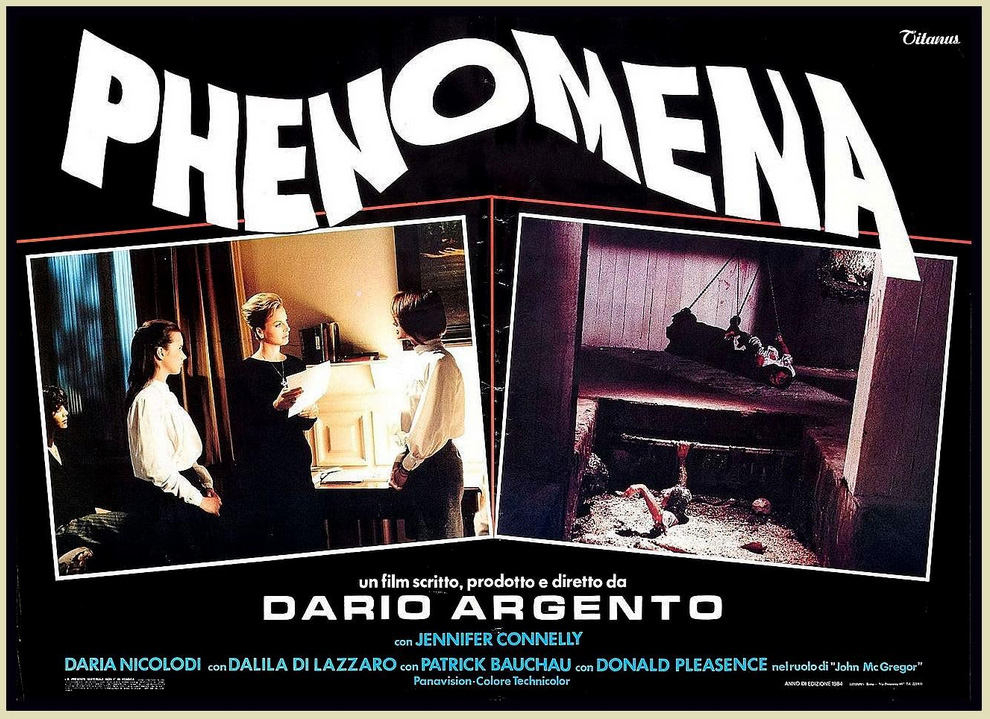
*This analysis will contain spoilers*
Jennifer couldn’t have arrived at boarding school at a worse possible time. A serial killer is on the loose, and the students are the main target. Bullied mercilessly by her peers, Jennifer befriends a paraplegic entomologist, John, and his helper chimp, Inga. Together, they work to stop the killer, and as their bond grows, John helps her tap into a power greater than she could have imagined. But now that she’s in the killer’s sights, will that power be enough to save her?
Dario Argento is, without question, one of the greatest film directors to ever walk this planet. After working with the legendary Sergio Leone to crack the story for Leone’s impeccable western, Once Upon a Time in the West, Argento exploded onto the scene in 1970 with his directorial debut, The Bird With the Crystal Plumage. With Bird, Argento didn’t invent the giallo; that was Mario Bava in 1964 with Blood and Black Lace, but he did take it mainstream. Unlike Blood and Black Lace, Argento’s debut was a smash hit, unleashing a wave of giallo films that would eventually number in the hundreds.
Throughout the 70s, ill-advised foray into comedy with The Five Days aside, Argento could do no wrong. He directed one hit after another, each arguably better than the last, culminating in one of the greatest and most genuinely frightening horror films ever made; the 1977 nightmare on celluloid, Suspiria. But with the new decade came new challenges. Argento would hit his first speed bump in 1980 with Inferno, his absolutely bonkers sequel to Suspiria. You haven’t seen ‘strange’ until you’ve seen a hotdog vendor run on water to hack a man to death who was being eaten by rats. It doesn’t make much sense in the movie either, but boy, is it cool. The film is a surrealist horror masterpiece that has only recently been reassessed as such, as it baffled critics and audiences at the time. To make matters worse, due to studio interference, Inferno received a very limited release in 1980 and didn’t reach North American shores until six years later. Needless to say, it bombed.
Feeling the sting of failure after Inferno, Argento decided to shelve supernatural horror for a bit and return to what made him a superstar: giallo. When he began writing his next film, Tenebrae, he drew upon a real-life incident in which he was stalked and threatened by a goddamned lunatic for weeks. Argento also states, bizarrely enough, that the film takes place years after an apocalyptic event wiped out a large portion of the population and destroyed many historical landmarks in Italy. None of this is stated, or even hinted at, in the film.
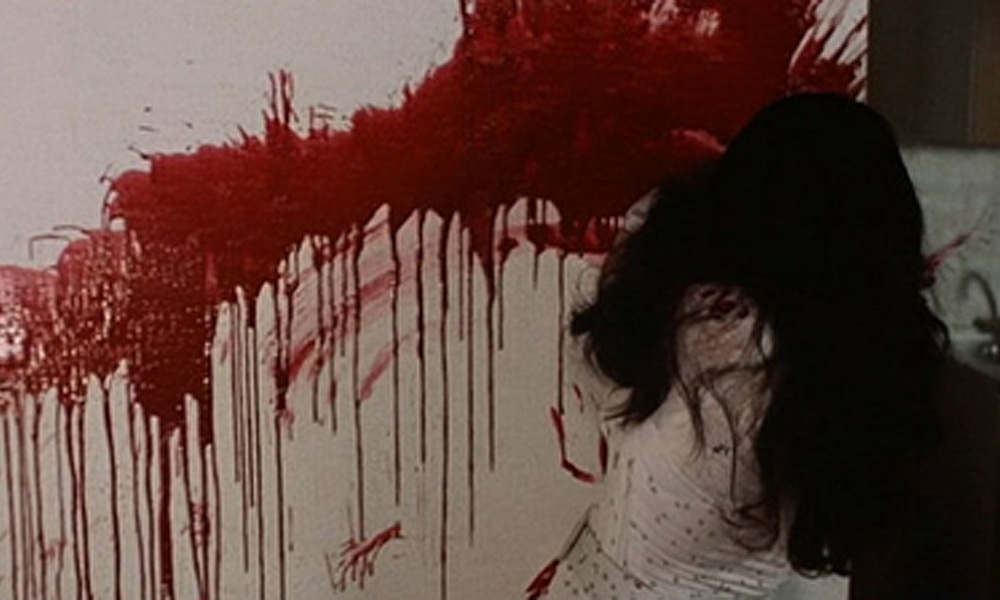
Oh, Dario, it’s this type of unhinged weirdness that makes us love you so! Tenebrae is a stunning achievement, featuring some of Argento’s best camerawork, including a nearly 3-minute-long one-take crane shot known as “the house crawl,” and some of the most violent kills in his filmography to date, averaging one murder every 10 minutes. Seriously, the sight of a victim getting her arm chopped off and spraying bright red blood onto a stark white wall like a friggin firehose is something you won’t soon forget! Tenebrae was released to acclaim in Italy, where it was a decent enough success, but it was pulled from theaters in the UK as a “video nasty.”
It didn’t have a proper release there until 1999, if you can believe that, and it fell victim, as many Italian horror films did, to US distribution difficulties. It wasn’t released in the States until 1984, where it was met with little fanfare, heavy censorship, and a new title: Unsane.
Feeling pretty good about the quality of Tenebrae and mildly pleased with its box office success, Dario took a little holiday with his mum in the French countryside to unwind and think about his next film. The remote location didn’t have television, so Dario spent a lot of time listening to the radio. One day, a report came over the airwaves about a murder solved through the study of insects.
Detectives on the case consulted an entomologist, who, probably while eating a sandwich, determined the approximate time of death by studying the developmental stages of the maggots at the crime scene. Inspiration struck, and the seed for Phenomena was planted. This feat of forensic ingenuity germinated into a mighty oak, if mighty oaks were made of pants-shitting insanity that makes the lunacy of Inferno look like a delightful 90s rom-com. That bit about Tenebrae taking place in a post-apocalyptic Rome? You ain’t seen nuthin’ yet. Argento was just getting warmed up.
Not content to just throw everything at the wall to see what stuck, Argento was going to load it onto a catapult like the bloated, plague-infected corpses the Mongols launched over the castle walls at Caffa, fire it at an unsuspecting public, and infect them with the diseased viscera expelled when it exploded on impact. Maybe it was a health scare, maybe it was the lingering effects of being stalked by a nutcase, but it’s as if he took the ideas for his next 12 films and combined them into a single movie in case he wasn’t going to be around to make them.
If this weren’t enough, Argento has stated that the film takes place in an alternate reality in which the Nazis won WWII. The kicker? Against all conceivable odds, the damn thing works. All of these crazy ideas coalesced into a hearty bisque of maggots, murder, mutants, telepathically controlled insects, vengeance-crazed, razor-wielding chimps, and the most inappropriately awesome use of heavy metal on a soundtrack since Slayer scored that documentary about children with leprosy. So grab a spoon, and let’s dig in!
Argento keeps the audience off balance by employing an unusual two-act structure, denying us the comfort and familiarity of a typical three-act narrative. The first act sees Jennifer arrive at the school, introduces the characters, and features several brutal murders. It sets the tone and draws us in with its almost suffocating atmosphere. The second act begins after we see Jennifer’s power fully unleashed. From that point forward, Argento piles on set piece after set piece, each more outrageous than the last, until the stunning climax.
The film opens with a young girl (Fiore Argento) who misses her tour bus in the Swiss countryside and seeks help at a nearby house. Inside, someone or something is chained to the wall and none too happy about the intrusion. She’s pursued to a scenic waterfall overlook where she’s stabbed and beheaded, thus keeping intact the Argento tradition of starting things off with a bang. Months later, Inspector Geiger (Patrick Bauchau) and his assistant (Michele Soavi) consult John McGregor (Donald Pleasence), a paraplegic entomologist with a helper chimp.
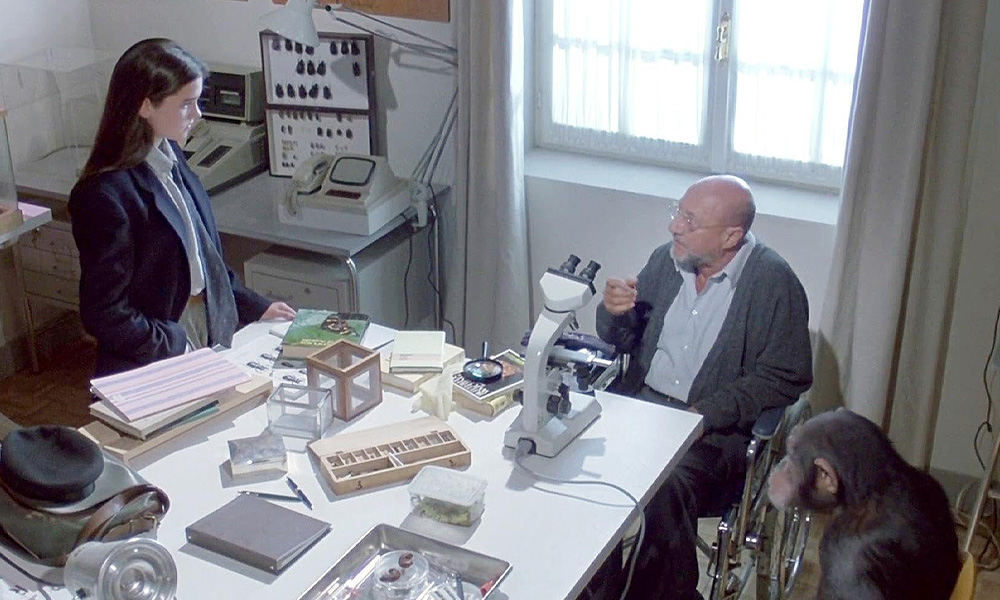
Not a helper monkey, mind you, because those are for idiots, but a helper chimp. John is helping them determine the time of death of the girl, whose decomposing head has been found. There’s a killer on the loose, and they need all the help they can get. After a scientific discussion about the life cycle of flies, he deduces that the murder occurred roughly eight and a half months earlier.
We then meet Jennifer Corvino (Jennifer Connelly) as she’s driven to the Wagner School for Girls, accompanied by Frau Bruckner (Daria Nicolodi). At school, she meets her roommate, Sophie (Federica Mastroianni), and the total bitch of a headmistress (Dalila Di Lazzaro) before turning in for the night.
Later, Jennifer gets up for a little sleepwalking as another girl is chased through the school grounds and into the nighttime woods, shot in a beautiful icy-blue palette, and into an abandoned building as ‘Flash of the Blade’ by Iron Maiden blasts on the soundtrack. Jennifer makes her way to a porch roof where the girl is murdered by a spear through the face. The roof gives way, Jennifer crashes through the bushes, wanders into traffic, gets clipped by a car, abducted by the dickhead drivers, dives out, and rolls down a hill. Jesus. We’re barely 15 minutes into the movie.
When she wakes up, she sees John’s helper chimp, Inga, and follows it to John’s house, as if spotting a chimp in the Swiss woods is perfectly normal. This sequence demonstrates Argento’s gift for economic storytelling, as he sets the stakes with a brutal murder and brings our two protagonists together in mere minutes. She tells John she remembers nothing, but he notices she has a strange effect on his insect collection.
Now, don’t let the videos of chimps wearing cute clothes, roller skating, and smoking cigars fool you; those things are assholes. The one playing Inga bit off part of Connelly’s finger while filming this scene, and for the rest of the shoot, it would flip out any time she was near it.
The next day, the headmistress is far more concerned with Jennifer’s sleepwalking than with the student who had her head skewered the night before. She orders a brain scan, but Jennifer isn’t having it; she runs out as the rest of the students gossip. That night, she begs Sophie to keep watch so she doesn’t sleepwalk again.
This lasts all of ten minutes before Sophie splits to meet up with her boyfriend with full knowledge that there’s a serial killer on the loose, a killer who is already stalking her. When Jennifer hears her screams, she investigates, and a firefly leads her to the killer’s glove. When she visits John, the insects sense her distress and start going nuts, but then she tells him that a maggot in the glove communicated with her telepathically, showing her the image of Sophie’s corpse via ‘maggot-cam.’ She feels better after getting this off her chest, and the insects immediately calm down.
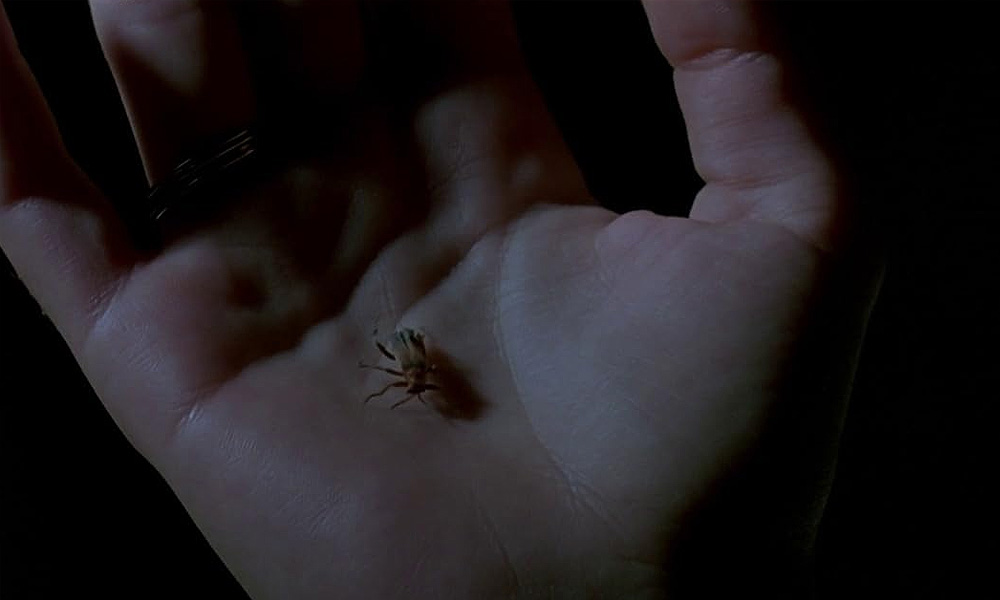
John tells her that ESP in insects is quite common, and that she may share this power. Later, after catching the headmistress reading her letter to her father in front of some students, she gets pissed, and the girls start making fun of her. They haze her until she snaps, and we see just how much power she exerts over insects when she gets mad:
“I love you. I love you all.”
We think she may be forgiving her fellow students, until millions upon millions of flies descend upon the school, sending her bullies into a panic. This display drains her energy, and she passes out. I wonder if this rare talent will pay off later.
Fed up, the headmistress arranges for Jennifer, the “Lady of the Flies,” to be taken to a nuthouse. Fortunately, the nurse keeping watch falls asleep, and Jennifer escapes to John’s house, just as he identifies the species of fly in the killer’s glove. It’s a Great Sarcophagus Fly, an insect that can smell a corpse from great distances. His plan for Jennifer: take the bus the girl from the beginning was on, with Inspector Geiger following, and the fly will let her know if they get close to any dead bodies. It works, and she ends up at the country house. I swear this movie is like a science book come to life at times. It’s abandoned, and a caretaker chases Jennifer away, but the fly finds a hand in the crawlspace.
After Geiger questions the caretaker, it’s obvious they’re getting close. This is bad news for John, though, because that night the killer goes to his house, locks Inga outside, and murders him. An enraged Inga attacks the car as the killer drives off, but the killer ditches her. Now on her own, Inga forages for food… and finds a straight razor in a garbage can.
Jennifer returns from her adventure just in time to see John being wheeled out of the house. She’s sad, but we’re not, because Argento has ‘Locomotive’ by Motörhead cranked up on the soundtrack. It’s inappropriate, it’s out of place, and it doesn’t just sound like it’s from another movie; it sounds like someone turned up the radio out of spite in a neighboring dimension.
Jennifer knows she’s next, and this sets the stage for the thrilling finale. She ends up at Frau Bruckner’s house for the night, while her father’s lawyer, Morris (Mario Donatone), makes his way across Europe to get her and bring her home. Inspector Geiger shows up, too, because his investigation has led him to Frau, who we’re now pretty sure is the killer. It seems she suffered an assault 15 years earlier, possibly sexual in nature, and this may have something to do with the murders. But the film cuts back to Jennifer just in time to hear Geiger scream. Jennifer makes a break for it as the heavy metal kicks in and Iron Maiden’s ‘Flash of the Blade’ makes an encore.
A series of mishaps lands her in the basement, where she falls into a grotesque cistern filled with maggots and rotting body parts. It’s fuckin’ gross. Geiger is down there too, bloodied and chained to the wall.
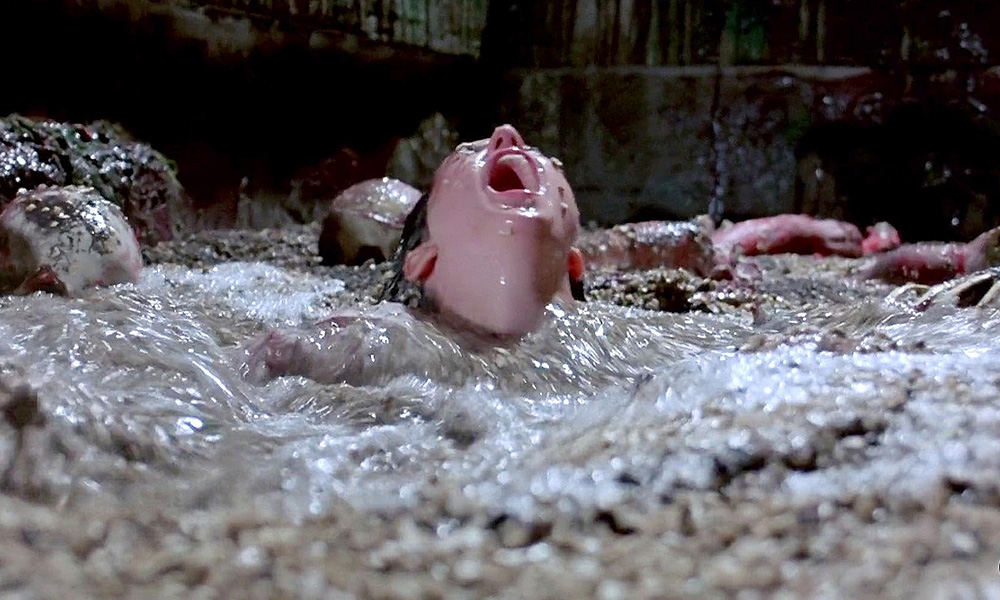
Then Frau appears, cackling like a maniac. Geiger breaks his own thumb, slips his hand out of the shackle, and starts beating the shit out of her. Jennifer escapes, and that’s when she finds Frau’s “ill” son hiding in a corner. Jennifer, ever the gentle soul, tells him everything is okay now. But he turns around to reveal his hideous mutant face: he’s the real killer. His modus operandi: sneak out, murder, then haul the bodies home so Frau can let them rot in the cistern. Jennifer runs to a nearby lake and jumps into a boat, but the mutant is on her heels and launches himself aboard with his spear and stabs at her, puncturing the gas tank and spraying gasoline everywhere.
That’s when Jennifer gets mad.
She calls down the swarm of flies, and the filthy things eat that little freak to death. After he falls into the lake, Jennifer starts the engine, igniting the spilled gas, and she jumps overboard as it explodes. But she’s not safe yet; freak-boy is still alive, face all mutilated, and tries to drown her. They rise from the water, but he comes up right into the flames and dies for real this time. She gets to the shore just as Morris arrives to take her home. But no, Frau jumps out of the shadows and cuts his damn head off with a piece of sheet metal.
She pins Jennifer to the ground, screaming exposition at her. Yes, her mutant son was the killer, but Frau also had to kill a few people here and there to protect the secret. She taunts Jennifer, daring her to call her insects. Things are looking bleak, but Inga the chimp arrives with her trusty straight razor and hacks Frau to ribbons, saving the day and avenging John. The two share a touching moment as the credits roll.
Now that is pure cinema. On paper, it absolutely should not work, but Argento in his prime was not a man to be doubted. We’re talking about an individual who built his career bottling pure, undiluted bedlam and bending it to his will like Poseidon causing an earthquake. With Phenomena, Argento creates a world in which chaos is so commonplace that a serial killer at large doesn’t instill fear, chimps appearing out of nowhere in Switzerland aren’t worth a second thought, and a schoolmistress with a crazed mutant child isn’t investigated when murders begin wherever she goes.
This is where the true terror lies: the idea that life can become so fraught with havoc that total pandemonium goes unnoticed. This is also why we fear for Jennifer; she represents, through fantastical means, stability. She is the vessel from which order emerges out of chaos. It’s a brilliant concept, expertly executed. Couple these ideas with the usual sublime acting from Donald Pleasence and a brilliant turn from a young Jennifer Connelly, and you have one of the greatest horror films of all time.
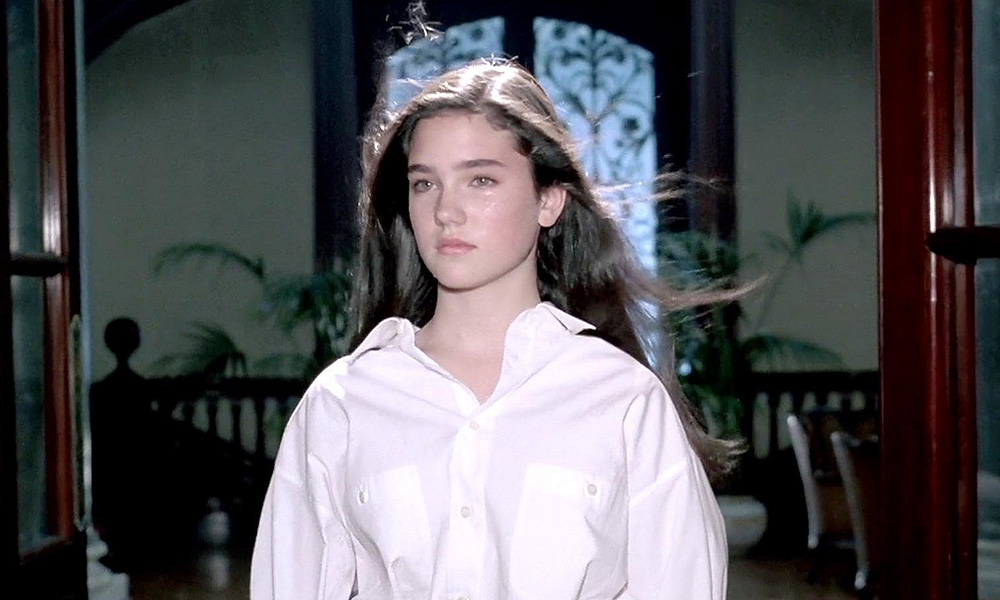
Phenomena would go down as Argento’s personal favorite of all his films, but there was nervousness leading up to its release. Early in the writing process, the main character was John McGregor, the entomologist, but Argento realized this guy, as written, was a bit stuffy and perhaps too much of a ‘know-it-all’ to connect with audiences. So he decided that one of the students should be the protagonist and made revisions. The rationale was that, since younger audiences were seeing these films, they would relate to Jennifer. This decision paid off with buckets of cash: Phenomena was released in Italy in January 1985 and became an instant box-office success.
Argento was back, and as big as Phenomena was in Italy, it was even bigger in Japan, where, according to Argento, girls began styling their hair and tailoring their wardrobes to match Jennifer Connelly’s look in the film. Even in America, where the film was trimmed by a jaw-dropping 28 minutes and retitled Creepers, it did especially well on the drive-in circuit, which is where I was unlucky enough to see it.
The distributor cut entire scenes, reordered others, and even removed Motörhead from the soundtrack. What kind of miserable son of a bitch cuts Motörhead?! These alterations left the film largely incoherent. Make no mistake: the ‘Creepers cut’ stinks and should be avoided.
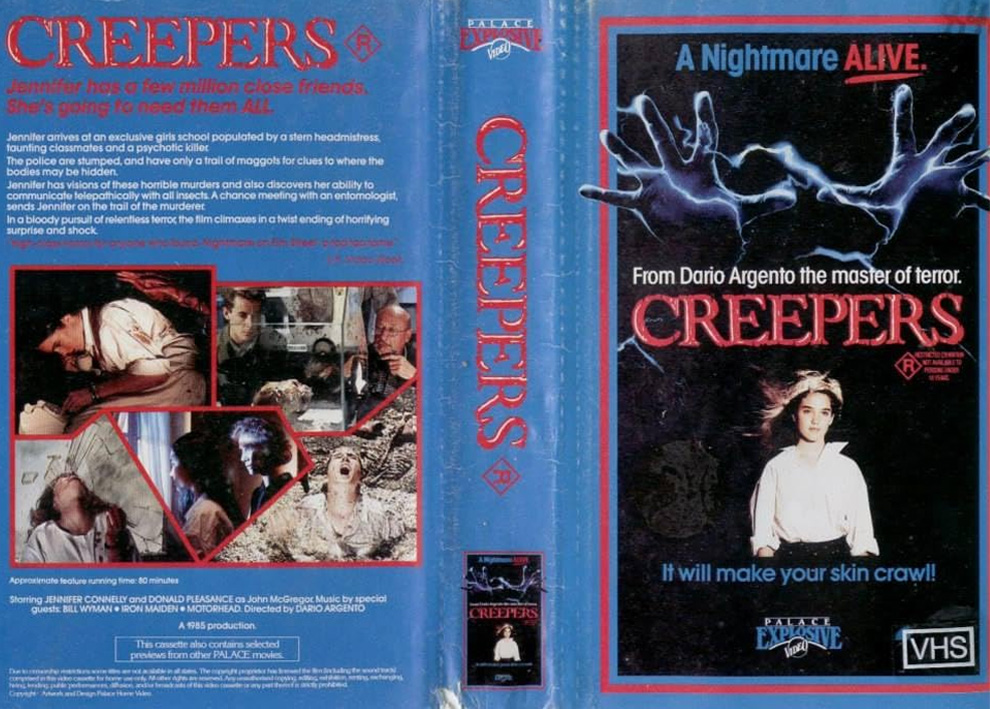
Argento had the hit he needed, but behind the scenes, things weren’t all smiles and sunshine. Tension had been mounting between Argento and his father, Salvatore, who was instrumental in securing larger budgets for his son’s films, and his brother, Claudio. So much so that Claudio was fired, or perhaps never brought on in the first place, from Phenomena before production began, and the relationship between Dario and Salvatore was so strained that Dario took over producing duties himself.
Worse, during filming, Argento split up with Daria Nicolodi, his longtime girlfriend and writing partner. While they would work together again on Opera and Mother of Tears, their creative and romantic partnership was over. In the moment, however, amidst all the hardship, Phenomena was one of the most successful films of Argento’s career, so we’ll take the win. Especially since in 1985, the decline of the Italian film industry was accelerating. Given these circumstances, the success of a masterpiece from one of the founding fathers of Italian horror was an increasingly rare and welcome gift.
10 maggot-infested skulls out of 10
-DwC

